 |
| UK Exclusive #1402 British Breeds 4 Piece Gift Set - Highland Pony (2006) |
Showing posts with label Footnotes. Show all posts
Showing posts with label Footnotes. Show all posts
Friday, August 05, 2016
Footnotes: It's Not Easy Being Green - Colour Issues
The issue with yellow and red paint continued with the G3 models. This problem was likely resolved sometime after 2006-ish as I haven't seen greenies later than this.

Tuesday, June 28, 2016
Birthday Week: Footnotes - Generation Two Customs
 |  |
| Legolas G2 Andalusian By Amanda Tolleson | G2 Clydesdale By Scrappy |
 |  |
| Fizzy Pop G2 Cantering Foal By Emily Miller | Achilles G2 Warmblood By Heather Wilkendorf |
 |  |
| G2 Warmblood By LeeAnn Bachman | G2 Andalusian By Scrappy |
 |  |
| G2 Clydesdale By LeeAnn Bachman | Galileo G2 Stock Horse By Heather Wilkendorf |
 |  |
| G2 American Saddlebred By Scrappy | Twilight Cookie G2 Warmblood By Billie Campbell |
 |  |
| G2 Paso Fino By LeeAnn Bachman | G2 Rearing Arabian By Scrappy |
 |  |
| Romeo G2 Andalusian By Horsing Around-England | Vertical Horizon G2 Mule By Unknown |
 |  |
| G2 Andalusian By Scrappy | Greek Upon the Stars G2 Warmblood By Kim Swanson |
 |  |
| G2 Shetland Pony By Scrappy | Allejandro III G2 Andalusian By M. Hildebrandt |
 |  |
| G2 Stock Horse By Scrappy | Me and My Monkey G2 Shetland Pony By Heather Wilkendorf |
 |  |
| Monkey Butter G2 Shetland Pony By Heather Wilkendorf | G2 Stock Horse By LeeAnn Bachman |
 |  |
| G2 American Saddlebred By Scrappy | G2 Shetland Pony By Scrappy |
 |  |
| Out of the Box G2 Thoroughbred By Bev Manderfeld | G2 Rearing Arabian By Scrappy |
 |  |
| G2 Warmblood By LeeAnn Bachman | Monkey in the Moon G2 Shetland Pony By Heather Wilkendorf |
 |  |
| G2 Paso Fino By Scrappy | G2 Prancing Morgan By LeeAnn Bachman |
 |
| MV Suprise Dream G2 Frolicking Foal By Mel Miller |
Many thanks to Emily Miller, Scrappy, Annmarie Pottrell, LeeAnn Bachman of Misty Star Studios, and Tess Carson for providing pictures for this post!
Friday, June 24, 2016


Thursday, June 23, 2016
Birthday Week: What's Yellow, Squashy, and Stamped All Over? - Production Issues
Mass-production doesn't mean problem-free and when you're working with plastic and paint, production can be rife with issues.
Yellowing


Rapid yellowing models seemed to be most common in 1997 and 1998, but these 2000-01 models obviously have the same issue. This doesn't seem to be a problem with later models, but for those produced between 1997 through 2001, keep them well away from the sun. The usual technique of sun-bleaching is not effective with these models.
Smooshed Shetlands

Starting in 2004 the forelock of the G2 Shetland Pony began to go a bit limp. This issue became worse over time and current models look very much like they've been hit with a hammer.
Stamp Swapping


The first of the G2 models were released with a small stamp with a 1998 date. In 2000 this stamp was replaced a 1999 one which was larger and the orientation was flipped.
Paint Problems

Breyer has released Stablemates in rubber tack without issue, but some times, whether due to paint which isn't completely dry, humidity, and/or heat, the tack causes damage. The paint can be completely lifted away, grooved, or just smeared.

The paint on some of the rapid-yellowing models could go a bit odd, looking pale and slightly green; later models were affected by a similar paint issue specifically those painted chestnut or "yellow", such as this #5601 Appaloosa.
Like the rapid-yellowing models, the paint goes pale and slightly green-toned though, with these later models, the white plastic is unaffected. I have models produced some time between 2006-08 with this issue as well.
Translucent Plastic

While this type of plastic was most common in 1997 during one of Breyer's obvious periods of plastic experimentation, translucent plastic still pops up now and then. I have several examples from the 2000-2006 period. The coloured areas on translucent models often look pearly or just extra shiny.
This translucent #5904 Palomino Pony has a smooshed forehead which means he was likely produced sometime between 2004-06 or may be a Target Special Run #720116 Shetland Pony from 2006. The regular run and special run are identical, the only change is in the run number, though translucents seem to be more common in the special run packaging.
Yellowing
Rapid yellowing models seemed to be most common in 1997 and 1998, but these 2000-01 models obviously have the same issue. This doesn't seem to be a problem with later models, but for those produced between 1997 through 2001, keep them well away from the sun. The usual technique of sun-bleaching is not effective with these models.
Smooshed Shetlands
Starting in 2004 the forelock of the G2 Shetland Pony began to go a bit limp. This issue became worse over time and current models look very much like they've been hit with a hammer.
Stamp Swapping
The first of the G2 models were released with a small stamp with a 1998 date. In 2000 this stamp was replaced a 1999 one which was larger and the orientation was flipped.
Paint Problems
Breyer has released Stablemates in rubber tack without issue, but some times, whether due to paint which isn't completely dry, humidity, and/or heat, the tack causes damage. The paint can be completely lifted away, grooved, or just smeared.
The paint on some of the rapid-yellowing models could go a bit odd, looking pale and slightly green; later models were affected by a similar paint issue specifically those painted chestnut or "yellow", such as this #5601 Appaloosa.
Like the rapid-yellowing models, the paint goes pale and slightly green-toned though, with these later models, the white plastic is unaffected. I have models produced some time between 2006-08 with this issue as well.
Translucent Plastic
While this type of plastic was most common in 1997 during one of Breyer's obvious periods of plastic experimentation, translucent plastic still pops up now and then. I have several examples from the 2000-2006 period. The coloured areas on translucent models often look pearly or just extra shiny.
This translucent #5904 Palomino Pony has a smooshed forehead which means he was likely produced sometime between 2004-06 or may be a Target Special Run #720116 Shetland Pony from 2006. The regular run and special run are identical, the only change is in the run number, though translucents seem to be more common in the special run packaging.
Sunday, June 28, 2015
Birthday Week - Footnotes: Modern (2010 & newer) Customs
New techiniques and sculpting materials, and changing style trends keep the Custom scene in a constant state of evolution.
Saturday, June 27, 2015
Birthday Week - Footnotes: One of These Things is Not Like the Others - G1 Oddities
In the early pre-China days of the Stablemate line production oddities, small unannounced Special Runs, and other unexplained phenomenonmenomenom were not uncommon.
In the possible unannounced special run category is the mystery buckskin Arabian stallion. The owner of the Arabian Stallion from the set was told it was a special run from the 70s and came with a black Swaps; Nancy Young was unable to find a second source or any further information. The Arabian Stallion is a mustard yellow buckskin (like the Quarter Horse Mare) with four stockings and grey hooves17, the Swaps is presumably a solid black as markings weren't mentioned.
In the possible unannounced special run category is the mystery buckskin Arabian stallion. The owner of the Arabian Stallion from the set was told it was a special run from the 70s and came with a black Swaps; Nancy Young was unable to find a second source or any further information. The Arabian Stallion is a mustard yellow buckskin (like the Quarter Horse Mare) with four stockings and grey hooves17, the Swaps is presumably a solid black as markings weren't mentioned.
Friday, June 26, 2015
Birthday Week - Footnotes: Almost Vintage (2000-2010) G1 Customs
Use of tools such as heat guns and air-brushes, and materials such as masking tape, pastels, and coloured pencils, and improvements in sculpting materials led to a substantial leap in the quality of finish work and detail possible.
Thursday, June 25, 2015
Birthday Week - Footnotes: Stamp of Approval - Evolving Bellies
As we've established, many of the G1 molds have twin molding cavities; others only seem to have one cavity, but have still undergone some changes.


G1 Draft Horse
"Floating" mark & "Tight" mark
G1 Draft Horse
"Floating" mark & "Tight" mark
Wednesday, June 24, 2015
Footnotes: Vintage (Pre-2000) Customs
While not Original Finish Breyer releases, customized models have a place in the Stablemate history. The availability of new molds and changing customization techniques keep the Live Show Custom divisions in a state of evolution.
In the early years of the hobby collectors were just beginning to experiment with the media. Oil, acrylic, spray paint, poster paint, wood filler, plumber's epoxy, mohair, synthetic hair, string, and hair from a range of other animals were often the materials of choice. Repositioning was frequently accomplished with hot water or a hair dryer. Some of the early efforts appear quite crude to us now, but were highly successful show horses in their time. If you are a fan of vintage customs, check out the Vintage Model Horse Cust Group on Facebook.
In the early years of the hobby collectors were just beginning to experiment with the media. Oil, acrylic, spray paint, poster paint, wood filler, plumber's epoxy, mohair, synthetic hair, string, and hair from a range of other animals were often the materials of choice. Repositioning was frequently accomplished with hot water or a hair dryer. Some of the early efforts appear quite crude to us now, but were highly successful show horses in their time. If you are a fan of vintage customs, check out the Vintage Model Horse Cust Group on Facebook.
Tuesday, June 23, 2015
Birthday Week - Footnotes: Special Run Releases Timeline and Distributor Chart
The timeline for the special run releases had to be split into two parts to make it a bit easier to display. Each image is linked to the file to make detailed viewing easier.

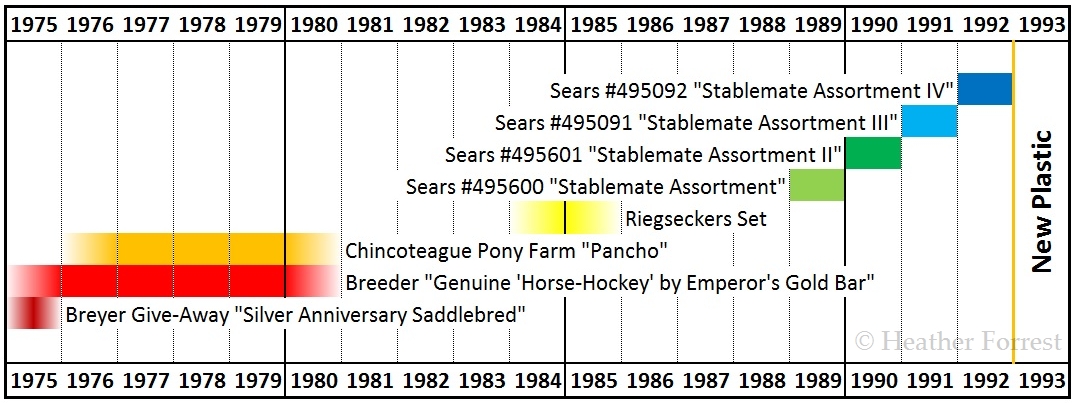
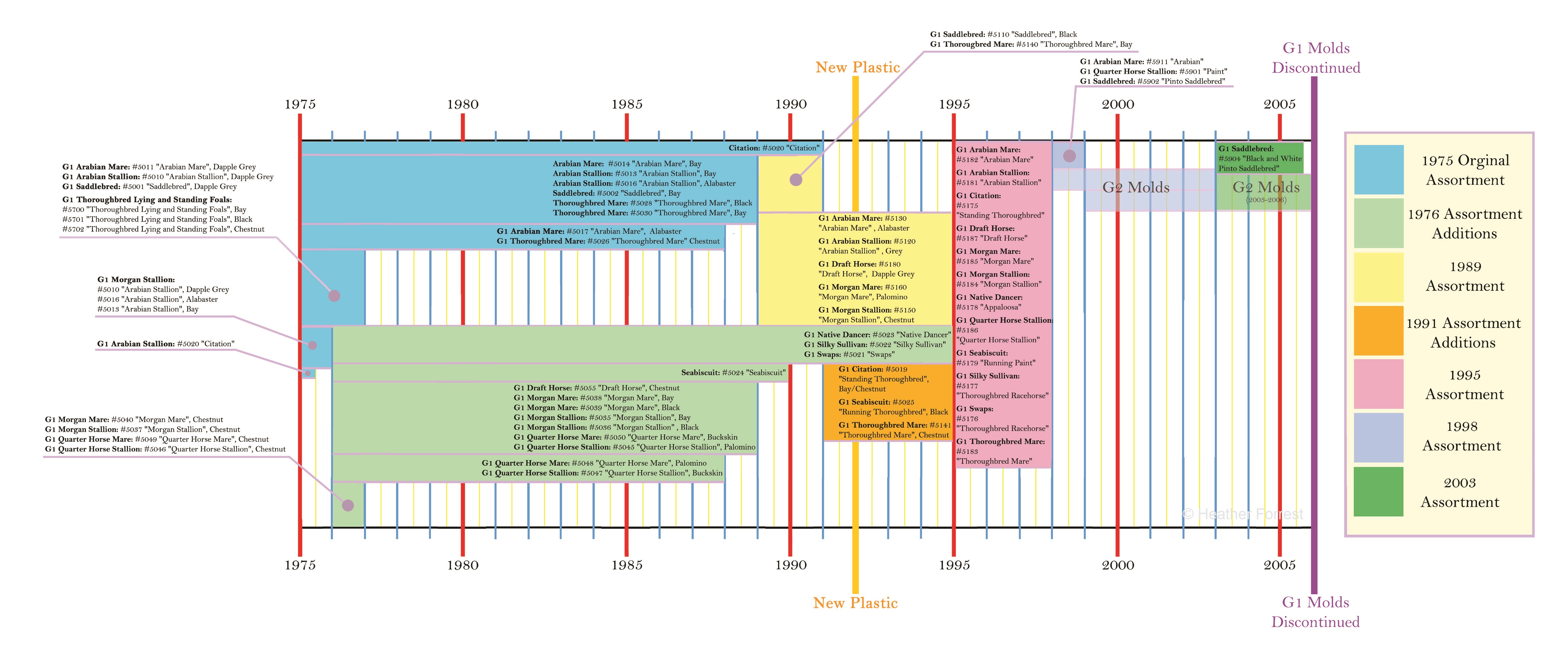
Birthday Week - Footnotes: Regular Run Timelines
If you've been reading here for a while you will know that I am a big fan of graphs, so I thought it would be fun to put some timelines together for the different Stablemate releases.
The first timeline shows the release history of the Stablemate Assortments only. You can view a larger image by clicking on the timeline.

The first timeline shows the release history of the Stablemate Assortments only. You can view a larger image by clicking on the timeline.
Monday, June 22, 2015
Birthday Week - Footnotes: I Can't Believe It's Not a Test Run - Custom Breyer Look-Alikes
There are some incredibly fun and creative customs out there, some of my favourites are the Breyer-style look-alikes. Dorothy Graham has created some lovely custom Stablemate-scale decorators and other iconic vintage Breyer colours.
Friday, June 19, 2015
Footnotes: That Inner Glow - Experiments in Plastic
For all we know, Breyer may experiment with different plastic types on a regular basis, always on the look-out for the more cost effective solution, but these experiments have only been obvious at a few points in Breyer History - first in the 1970s during the oil crisis and more recently during the late 1990s. One of these, the not so mellow yellowing plastic, we discussed last year, the others we've mentioned in passing at
Friday, May 08, 2015
Footnotes: Don't Squeeze the Citation! - Squeezies and Other Production Irregularities
The birth a Breyer should be simple, right? Pour the melted plastic in the mold, let it cool a little, then pop out the little plastic horse. The still-warm model gets set aside to cool completely, then it's off for prepping which smooths off rough seams and prepares it for painting. Finally the paint is applied and the finished model is left to dry before packaging. Simple, except there's many a slip twixt the mold and the box.
Who would think the simple task of moving a freshly molded, warm Stablemate from the mold to the cooling area could be so fraught with peril? One minute everything's fine, then the person carrying you sneezes, involuntarily tightening their grip, and now you've got a flat shoulder, or a sway back, or a tucked head. The effect can be subtle or extreme; a deformity or an enhancement - it's all luck. I affectionately call this type of model a "Squeezie".
Many of the more subtle alterations go unnoticed.

I only noticed the curled ear because I was looking for some way to tell these two mares apart.

I bought the chestnut G1 Draft Horse in 2004 and it only took me ten years to notice his off-hind leg was extended further than normal. This isn't an uncommon issue for this mold.


The moved areas on this unpainted Riegseckers SR is difficult to photograph. The ribcage on the off-side has been smooshed down and the off-hind leg is stretched out a bit.


Speaking of outstretched legs, have a look at this G1 Swaps!
Extreme heat can cause non-factory warping, but the models above were either purchased new in package in their current state or, as in the case of the Draft Horses, are difficult to bend.
Unlike the Squeezies, molding issues usually have less than attractive outcomes.


Something happened to this 1995-97 Citation during the injection process leaving her with an off-fore hoof even more deformed than what has become typical and toothpick for a cannon bone. Ouch! Her off-hind hoof is also less than normal and she has a factory-original missing ear-tip. This is probably caused by gunk getting stuck in the mold.
The molds weren't the only part of the process that could go awry. The type of plastic used could also cause some fluctuations in the final product. It's easiest to see when you have a good sized conga, but it only takes two to notice not all Stablemates are created equal.

The shockingly yellow palomino is an old plastic 1990 SR while the seemingly massive grey is a new plastic SR from 1998. In general, new plastic models tend to be larger than old plastic models, but there is a certain amount of inconsistency between models of the same plastic type.
The G1 Swaps mold apparently suffered a minor malfunction early in its life. The space between the curve of the tail and the leg on the very earliest models is a clean, uniform gap.

Very shortly after the release of the Swaps mold, something happened - maybe a pinhole leak, maybe the mold not fitting quite tightly enough in the one spot - to cause plastic to leak into the tail gap, forming a thin skin. In 2005, the last year of production for this mold, Swaps began to appear with a tail hole again. This time the hole was hand-carved, not molded. As part of the preparation process, each model would get a quick little zip with a dremel; not being molded, these holes were not uniform and could often take a bit of the haunch or tail with them.
While not exactly a flaw as a little work with a fingernail can correct the issue, forgotten masking stickers are a production irregularity.
I regret taking the blaze sticker off of my 1998 regular run G1 Quarter Horse Stallion, but this Lying Thoroughbred Foal is a lovely example, even if she's not mine.
Who would think the simple task of moving a freshly molded, warm Stablemate from the mold to the cooling area could be so fraught with peril? One minute everything's fine, then the person carrying you sneezes, involuntarily tightening their grip, and now you've got a flat shoulder, or a sway back, or a tucked head. The effect can be subtle or extreme; a deformity or an enhancement - it's all luck. I affectionately call this type of model a "Squeezie".
Many of the more subtle alterations go unnoticed.
I only noticed the curled ear because I was looking for some way to tell these two mares apart.
I bought the chestnut G1 Draft Horse in 2004 and it only took me ten years to notice his off-hind leg was extended further than normal. This isn't an uncommon issue for this mold.
The moved areas on this unpainted Riegseckers SR is difficult to photograph. The ribcage on the off-side has been smooshed down and the off-hind leg is stretched out a bit.
Model and picture owned by MySt and used here by permission. Standard G1 Swaps.
Speaking of outstretched legs, have a look at this G1 Swaps!
Extreme heat can cause non-factory warping, but the models above were either purchased new in package in their current state or, as in the case of the Draft Horses, are difficult to bend.
Unlike the Squeezies, molding issues usually have less than attractive outcomes.
Something happened to this 1995-97 Citation during the injection process leaving her with an off-fore hoof even more deformed than what has become typical and toothpick for a cannon bone. Ouch! Her off-hind hoof is also less than normal and she has a factory-original missing ear-tip. This is probably caused by gunk getting stuck in the mold.
The molds weren't the only part of the process that could go awry. The type of plastic used could also cause some fluctuations in the final product. It's easiest to see when you have a good sized conga, but it only takes two to notice not all Stablemates are created equal.
The shockingly yellow palomino is an old plastic 1990 SR while the seemingly massive grey is a new plastic SR from 1998. In general, new plastic models tend to be larger than old plastic models, but there is a certain amount of inconsistency between models of the same plastic type.
The G1 Swaps mold apparently suffered a minor malfunction early in its life. The space between the curve of the tail and the leg on the very earliest models is a clean, uniform gap.
Very shortly after the release of the Swaps mold, something happened - maybe a pinhole leak, maybe the mold not fitting quite tightly enough in the one spot - to cause plastic to leak into the tail gap, forming a thin skin. In 2005, the last year of production for this mold, Swaps began to appear with a tail hole again. This time the hole was hand-carved, not molded. As part of the preparation process, each model would get a quick little zip with a dremel; not being molded, these holes were not uniform and could often take a bit of the haunch or tail with them.
While not exactly a flaw as a little work with a fingernail can correct the issue, forgotten masking stickers are a production irregularity.
 |
| Model and picture owned by MySt and used here by permission. |
I regret taking the blaze sticker off of my 1998 regular run G1 Quarter Horse Stallion, but this Lying Thoroughbred Foal is a lovely example, even if she's not mine.
Many thanks to MyST for providing a picture of her G1 TB Foal!
Subscribe to:
Posts (Atom)